

Fall Driving: Why a Seasonal Check-Up is More Than Just An Oil Change
November 3, 2026
Brakes on an Older Car Before the Thanksgiving Drive
November 19, 2026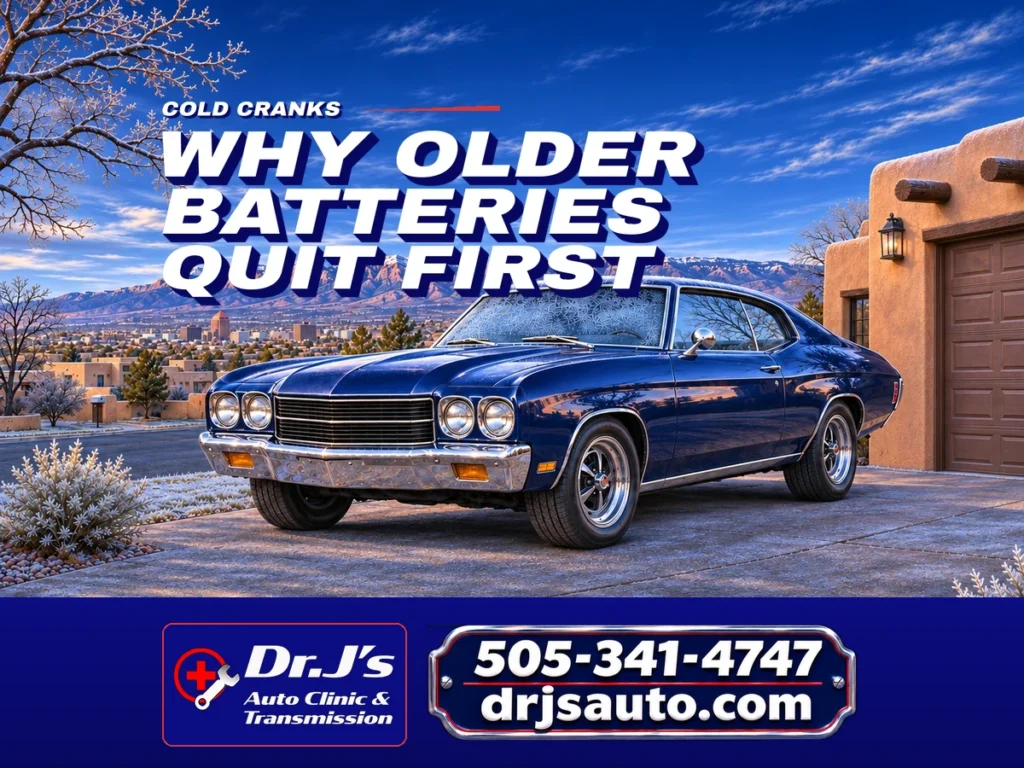
The first hard freeze in Albuquerque is when batteries give up, and older cars are the first to go. A battery that started the car all summer can leave you with a slow crank or a click on a 25 degree morning. Through November 30, our Winterization Service is $54.95 and includes a battery test and a charging system check, so you can find out where yours stands before it decides for you.
- Summer heat does the damage to a battery, and the first freeze is when that damage shows
- Older cars add their own problems: corroded terminals, tired cables, weak grounds and worn alternators
- A load test and a charging system check tell you more than a voltage reading ever will
Heat Does the Damage, Cold Exposes It
Most drivers blame the cold when a battery dies in December, but the real wear happened in July. High underhood temperatures speed up the chemical breakdown inside a battery and evaporate the fluid that keeps the plates working. By fall the battery has lost capacity, and nothing about the way the car starts on a mild morning will tell you so.
Then the temperature drops. A cold battery delivers less cranking power, and cold engine oil is thicker, so the starter needs more power at the exact moment the battery has less to give. That gap is why a battery that seemed fine at Halloween fails the week after Thanksgiving. In our climate, three to five years is a typical battery life, and a battery past the four year mark deserves a test every fall.
Why Older Cars Lose First
A new battery in a new car is working with clean connections and fresh wiring. A car with 150,000 miles on it is not. Every connection between the battery and the starter adds a little resistance as it ages, and resistance steals the power the starter needs.
These are the trouble spots we see most often on older and high-mileage cars:
- Corroded battery terminals, with white or green buildup on the posts
- Battery cables that have corroded under the insulation, where you cannot see it
- Ground straps between the engine and the body that are loose, frayed or rusted
- An alternator that still charges, but no longer at full output
- A small electrical drain that pulls the battery down while the car sits
Any one of these can make a good battery act like a bad one. That is why replacing the battery does not always fix a slow start on an older car, and why the second new battery sometimes fails as quickly as the first. The battery is one part of a system, and on an older car the rest of the system needs a look too.
What a Real Battery Test Covers
A voltage reading alone does not tell you much. A battery can show 12.6 volts sitting still and collapse the moment the starter asks it for power. A load test measures how the battery performs under demand, which is the only number that matters on a cold morning.
A charging system check goes with it. We look at what the alternator puts out with the engine running, how the starter draws power, and the condition of the terminals and cables. If the battery is weak, you will know before it strands you. If the battery is healthy and the problem is a cable or a ground, you will not pay for a battery you did not need.
Signs Your Battery Is Running Out of Time
Batteries usually give a warning before they quit. Watch for an engine that cranks slower than it used to, headlights that dim at idle and brighten when you rev the engine, a battery warning light, or a need for a jump start more than once. If the battery is more than four years old, treat any one of these as a reason to have it tested now. A test takes a few minutes. A tow from a cold parking lot takes most of a morning.
Our Winterization Service covers the battery and charging system along with the cooling system and antifreeze, tires, brakes, belts, hoses, heater, defroster and wiper blades, plus an oil and filter change with up to 5 quarts of oil. It is $54.95 through November 30, 2026. Call 505-341-4747 to get on the schedule before the next cold snap.
Dr. J’s Auto Clinic and Transmission
11200 Candelaria Rd NE
Albuquerque, NM 87112
505-341-4747