

Why a Summer Tune-Up Matters: Ignition Coils, Misfires, and Up to $25 Back at Dr. J’s
July 1, 2026
Record Heat Through Friday, and Why We Extended the Free AC Check Through September
August 26, 2026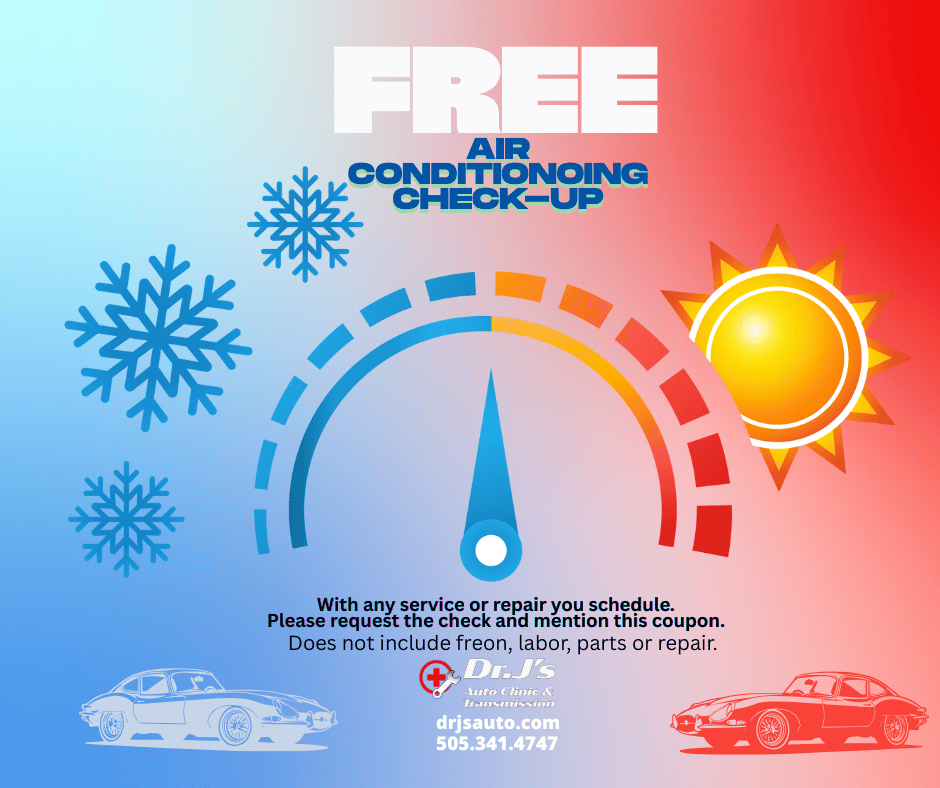
The National Weather Service has Albuquerque sitting at 96 to 98 degrees every day this week, and the long-range picture does not offer much relief. Our thirty-year normal high for August is 89 degrees, which means the city is running seven to nine degrees hot. Drivers who have been nursing a weak air conditioner since June are about to find out how much heat their system can actually take. If your AC is already struggling, waiting for cooler weather is not a plan.
- Albuquerque’s normal September high is still 83 degrees, so there are roughly six more weeks of real AC weather ahead
- Most air conditioning failures announce themselves weeks in advance through warm air at idle, weak airflow, or a musty cabin smell
- A performance check catches low refrigerant, leaks, and failing components before the compressor takes the damage
Why Late Summer Is Hardest on Your AC
An automotive air conditioning system is a sealed loop that depends on refrigerant, pressure, and airflow all staying in balance. By early August, that system has been running near capacity for two months straight. Heat is the stress that exposes every small weakness in it. A refrigerant charge that was slightly low in May will read badly low now, and a system running low on refrigerant is also running low on the oil that circulates with it. That is the sequence that turns a minor service into a compressor replacement, because the compressor is the one component that cannot survive running dry.
Albuquerque adds a second problem on top of the heat. Dust and fine grit load up cabin air filters and pack the condenser fins at the front of the vehicle. The condenser sheds heat from the refrigerant, and it can only do that if air moves through it. A condenser packed with road dust, cottonwood fluff, and grasshopper remains loses efficiency even when everything else in the system is healthy. On a 97-degree afternoon, that lost efficiency is the difference between cold air and disappointing air.
Warning Signs Worth Acting On
Air conditioning rarely fails without notice. The symptoms are just easy to explain away when you are only in the car for fifteen minutes at a time. Watch for these:
- Air that is cold on the highway but turns warm when you stop at a light
- Airflow that has quietly weakened over the summer, even on the highest fan setting
- A musty or sour smell in the first minute after startup
- Clicking, cycling, or a noticeable engine shudder when the AC engages
- Water pooling on the passenger floorboard
Warm air at idle is the one people most often ignore, and it is usually the most informative. At a stoplight there is no ram air pushing through the condenser, so the system has to rely on the cooling fan alone. When performance drops off at idle, it typically points to low refrigerant, a struggling fan, or a condenser that cannot shed heat. Each of those has a straightforward fix if it is caught before the system starts eating itself.
What an AC Performance Check Actually Involves
A proper check is not a can of refrigerant and a hopeful thumbs up. Our technicians read high-side and low-side pressures with the system running, measure the actual vent temperature against what the system should be producing at the current ambient temperature, and inspect the compressor clutch, belt, condenser, and cabin filter. If pressures suggest a loss of charge, the next question is where it went, because refrigerant does not get consumed. It escapes. Finding that leak with dye or an electronic detector is what separates a repair from a temporary recharge that fails again in three weeks.
That distinction matters financially. A leak found in August is usually a seal, an O-ring, or a service port valve, and the repair is modest. The same leak ignored until the compressor runs low on oil and seizes turns into a compressor, condenser, receiver drier, and full system flush. The gap between those two invoices is substantial, and the only variable is timing.
Why We Are Requiring Appointments
Our AC Performance Check is by appointment only this month, and that is deliberate. A real diagnosis takes bay time, gauges, and a technician who is not being pulled off the job every ten minutes. Scheduling means your vehicle gets the full evaluation instead of a rushed look between walk-ins, and it means we can tell you honestly the same day what your system needs. Call ahead and we will find you a slot. Show up unannounced in the middle of a heat wave and we cannot promise you anything.
There is no reward for waiting this one out. September in Albuquerque still averages 83 degrees, and this city has recorded a 100-degree day as late as September 5. Call Dr. J’s Auto Clinic at 505-341-4747 to schedule your AC Performance Check while appointments are still open this month.
Dr. J’s Auto Clinic and Transmission
11200 Candelaria Rd NE
Albuquerque, NM 87112
505-341-4747